
I have recently been trying to spin some fiber from another dyer, who has a reputation for good fiber prep. And I have to say that I'm a little shocked that people would consider this to be good. Yes, anyone can have a bad day and turn out something that's not up to their usual standard. But I had two braids, and to let two of these slip through the QA process seems like it's a standard rather than an exception.
One braid is a total loss--the felted bits of Wensleydale are knot-like, and despite the gorgeous colors, I've given up on spinning it. Disappointing, because I was looking forward to spinning my first longwool. But hey, maybe it was me, as a newer spinner working with a more challenging fiber.
Because the first braid was a waste of money, I was determined to spin the other braid, which was 100% BFL, a fiber I have dyed hundreds of times and am very familiar with. Imagine my disappointment when this, too, turned out to be difficult to spin. It's technically spinnable after you rip it apart sideways, and I've spun nearly 2 oz of it so far. But it doesn't draft easily at all, and leaves my thumb and forefingers aching for the next day, with tenderness radiating up to my shoulder and neck. I've decided that despite the lovely colors, it's not worth it to me to spin the rest of the braid. I have enough joint problems as it is.
Yes, people are always saying, "Don't spin bad fiber--sheep grow more wool all the time." But the fact of the matter is that buying fiber COSTS MONEY, and when you work hard for it, it's painful to just throw it away.
This experience has gotten me thinking about what I consider to be fiber dyeing rules. Others may dye it differently with great results, but here's what works for me.
1. Thou shalt not touch the fiber when it is hot. When you're intentionally felting/fulling fiber, you put it in the hottest water you can stand, with detergent, and agitate it. When you're dyeing fiber, hot water is unavoidable--it's an essential part of the process (unless you're talking about plant fibers and fiber reactive dyes--totally different process that I don't use). And detergent is present as well, since it helps to open up the fiber and remove the last bits of processing residue. Only the last leg of the felting triumvirate is missing--agitation. KEEP YER HANDS OFF OF IT. I try to avoid even bumping the pot.
How do I define "hot"? Anything higher than room temperature. If it's even a little bit warm, I keep my paws off the pot. Room temperature does vary with the season, and I dye fiber with as much success during the summer as the winter in my unheated garage--so I often try to justify to myself that if it just gets down to about 70, it's okay to rinse. But I talk myself out of it. Cutting corners to save some time often means that I just end up having to redo the whole thing again. It's not a timesaver at all.
2. Thou shalt not rinse too many times. Sad to say, I have (in my opinion) ruined BFL/silk with too many rinses. Last year, I did have a customer who bought one of my seconds at Black Sheep Gathering come and find me at Sock Summit, so that she could tell me that there was nothing wrong with my "second quality" braids. I'm not sure if I'm too picky or if customers are accustomed to doing some yanking and pulling during drafting. But ...
3. Thou shalt err on the side of being too picky. Every time that I'm on the fence about whether something is first quality or not, I throw it in the seconds bin. I think, "If this is the only thing of mine that this customer sees, would I want this to be her or his only impression of my work?" When I put it that way, the answer of what to do is always clear, even if it costs me some money.
4. Thou shalt not dye fiber for wholesale. I do have exceptions to this commandment, as I have retailers who take my product to shows that I can't vend at myself. But generally, when I'm filling a wholesale order, I'm dyeing colorways chosen by someone else, and attempting to match a stock photo. I'm focusing on accuracy, and if an interesting variation or idea pops up, I don't pursue it. By keeping fiber at a retail level, I'm preserving a certain creative freedom that makes me a better dyer.
Showing posts with label dyeing. Show all posts
Showing posts with label dyeing. Show all posts
Saturday, March 17, 2012


Saturday, March 13, 2010
blue is beautiful
In between yarn club orders, I decided to use up some odds and ends of dye solutions that have been accumulating on my dye table. It's about time, since I botched a batch of yarn last night by confusing my purple and black dye bottles. Oops. They're pretty, but not what my customers are expecting to get.
I had a lot of blue and green solutions around. So I dyed a few skeins of Joy, a big skein of Colleen, and some random blue/green colorways. It's nice to just pour some dye in a pot and see what happens, instead of trying to match a stock photo.
It was a warm (for March) day, so I hung them outside to dry. I liked how they looked, so I snapped a photo. It looked better in real life, I'm sorry to say, since the sun came out just in time to wash out the colors. You can't see the interesting variations in shading in the Colleen (the semi-solid green skein) or the two sea-blue skeins at the other end of the line.

My husband rigged this clothesline for me last year. I like it because it's under the eaves of the roof. Maybe I'm the only paranoid dyer out there, but whenever I see photos of people hanging dozens of skeins outside to dry, I always think about bird poop. I've got drying racks that I put out in the driveway during warm weather, but I know that my little feathered friends like to perch on the phone lines right over them, so the clothesline is my first choice for hanging yarn. It also catches the breeze a bit better up there, and during the summer, the bricks radiate additional warmth.
I had a lot of blue and green solutions around. So I dyed a few skeins of Joy, a big skein of Colleen, and some random blue/green colorways. It's nice to just pour some dye in a pot and see what happens, instead of trying to match a stock photo.
It was a warm (for March) day, so I hung them outside to dry. I liked how they looked, so I snapped a photo. It looked better in real life, I'm sorry to say, since the sun came out just in time to wash out the colors. You can't see the interesting variations in shading in the Colleen (the semi-solid green skein) or the two sea-blue skeins at the other end of the line.
My husband rigged this clothesline for me last year. I like it because it's under the eaves of the roof. Maybe I'm the only paranoid dyer out there, but whenever I see photos of people hanging dozens of skeins outside to dry, I always think about bird poop. I've got drying racks that I put out in the driveway during warm weather, but I know that my little feathered friends like to perch on the phone lines right over them, so the clothesline is my first choice for hanging yarn. It also catches the breeze a bit better up there, and during the summer, the bricks radiate additional warmth.
Monday, January 25, 2010
tired
My husband took the kiddo away for the weekend so I could spend it dyeing. Worked my butt off, but I'm still terribly behind where I need to be. Plus I have to do my city and state taxes this week (ugh!), and dye for my yarn club.
I've come to the unhappy conclustion that I am just a slow dyer. I can whip through colorways that involve just one or two dye solutions, but the more complex colorways just take forever. I don't know how other people do it, but I wish I knew their secret.
I've come to the unhappy conclustion that I am just a slow dyer. I can whip through colorways that involve just one or two dye solutions, but the more complex colorways just take forever. I don't know how other people do it, but I wish I knew their secret.
Thursday, August 20, 2009
how quickly we forget
Tonight I dyed yarn for the first time since Sock Summit. It's only been two weeks, yet I'd forgotten two of the basics:
1) Always tie your yarn in a few places before you put it in the dyepot. I have no idea how I managed to forget, but I was skeining yarn off cones this afternoon and forgot to tie up one of the skeins . Took it out of the spin dryer and it fell apart, of course. Luckily it was only an ounce of worsted yarn, so it didn't take me too long to untangle it, but how on earth did I manage to take it off my yarn winder without tying up at least the loose ends?
2) When you peek into your dyepot, don't forget that steam is hot. I scalded my forearm with that initial gush of steam after I lifted the lid. It still hurts, though not as much as my pride.
The dyeing itself went well, I think. It's intended to be a Queen of Hearts colorway for an upcoming Alice in Wonderland theme at Venus Vanguard. It will cool in the pot overnight, so we'll see tomorrow how it turned out.
1) Always tie your yarn in a few places before you put it in the dyepot. I have no idea how I managed to forget, but I was skeining yarn off cones this afternoon and forgot to tie up one of the skeins . Took it out of the spin dryer and it fell apart, of course. Luckily it was only an ounce of worsted yarn, so it didn't take me too long to untangle it, but how on earth did I manage to take it off my yarn winder without tying up at least the loose ends?
2) When you peek into your dyepot, don't forget that steam is hot. I scalded my forearm with that initial gush of steam after I lifted the lid. It still hurts, though not as much as my pride.
The dyeing itself went well, I think. It's intended to be a Queen of Hearts colorway for an upcoming Alice in Wonderland theme at Venus Vanguard. It will cool in the pot overnight, so we'll see tomorrow how it turned out.
Friday, July 24, 2009
when 2 a.m. starts feeling like an early bedtime
... you know you have a problem. I can turn off the dyepot in 10 minutes and go to bed, and it's going to feel pretty darn good. I still have to go to work tomorrow. Ugh.
I'm in the homestretch now--the last week of dyeing before Sock Summit. July 30 will be my last dyeing day, and then it's on to labeling and other prep. For my day job, I have a Rubbermaid tote that I call my event box, with all the possible supplies that I might need for a public meeting. I wanted to start putting together my event box for Sock Summit starting in April, and I did pull together a list, but I don't have the actual box yet. All the boxes I was planning to use are full of yarn.
The Dye for Glory contest has started on Ravelry. I have two entries. Of course, I got a bunch of ideas for colorways the day that entries closed ... oh well. I'll jot them down and pursue them after Sock Summit.
My entry in the handpainted category, Winesap (another of my apple-themed colorways). Lots of different shades of green, with burgundy and rose, anchored by warm brown:

And this is my shaded solid entry, Limitless, based on my favorite shade of blue--the color of the evening sky just after the sun drops below the horizon, when the blue seems like it goes on forever:

I'm in the homestretch now--the last week of dyeing before Sock Summit. July 30 will be my last dyeing day, and then it's on to labeling and other prep. For my day job, I have a Rubbermaid tote that I call my event box, with all the possible supplies that I might need for a public meeting. I wanted to start putting together my event box for Sock Summit starting in April, and I did pull together a list, but I don't have the actual box yet. All the boxes I was planning to use are full of yarn.
The Dye for Glory contest has started on Ravelry. I have two entries. Of course, I got a bunch of ideas for colorways the day that entries closed ... oh well. I'll jot them down and pursue them after Sock Summit.
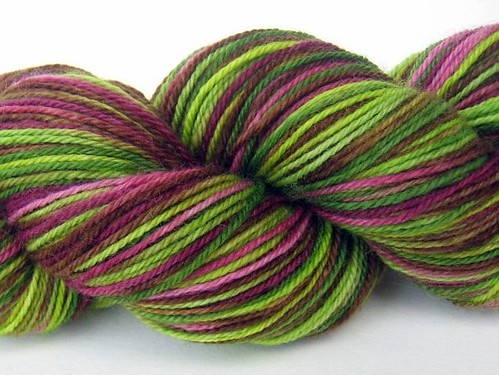
My entry in the handpainted category, Winesap (another of my apple-themed colorways). Lots of different shades of green, with burgundy and rose, anchored by warm brown:
And this is my shaded solid entry, Limitless, based on my favorite shade of blue--the color of the evening sky just after the sun drops below the horizon, when the blue seems like it goes on forever:

Thursday, May 28, 2009
dyepot--you're in timeout!
First batch of colorways went well today, second batch did not. Argh. As my stressbuster, I'm going to sit outside and try out my new Hiya Hiya circulars on Delphine, before I have to scurry into work. Am using my sport weight organic merino dyed in Huckleberry, which is so nice to knit. Smooth and silky. That should put me in a better mood.
Preparing for Sock Summit is a marathon, but as Thursday is my main dyeing day, it always feels like a frantic sprint. I probably need to pace myself better during the week so that I'm not so stressed out on Thursday.
Preparing for Sock Summit is a marathon, but as Thursday is my main dyeing day, it always feels like a frantic sprint. I probably need to pace myself better during the week so that I'm not so stressed out on Thursday.
Wednesday, May 20, 2009
get your geek on!
My friend P. pointed out that when I get interested in something, I focus on it obsessively. Battlestar Galactica, the best TV series I've ever watched, is no exception. I was pretty much in mourning when the series ended in March.
Naturally, it ended up merging with my ongoing obsession with yarn. (Basically everything does, these days.) I started thinking about BSG colorways. Then about all the other great science fiction and fantasy stories out there.
But why geek alone? I picked a few friends who I suspected of similar tendencies, and invited them to stock my store with me.
Tomorrow morning, the collision of art and fandom goes live. A few examples:
Centurion (BSG)

Tribbles (Star Trek: TOS)

Mal's Browncoat (Firefly)

Team Edward (Twilight)

There were so many other ideas I had (Lorien from LOTR, Lyra's hat from The Golden Compass, Jayne's hat from Firefly, and my Coldfire colorway), but alas, just didn't have time. Hopefully I will the next go-around ...
Naturally, it ended up merging with my ongoing obsession with yarn. (Basically everything does, these days.) I started thinking about BSG colorways. Then about all the other great science fiction and fantasy stories out there.
But why geek alone? I picked a few friends who I suspected of similar tendencies, and invited them to stock my store with me.
Tomorrow morning, the collision of art and fandom goes live. A few examples:
Centurion (BSG)
Tribbles (Star Trek: TOS)
Mal's Browncoat (Firefly)
Team Edward (Twilight)
There were so many other ideas I had (Lorien from LOTR, Lyra's hat from The Golden Compass, Jayne's hat from Firefly, and my Coldfire colorway), but alas, just didn't have time. Hopefully I will the next go-around ...
Monday, May 18, 2009
playing around in the dye studio
One of my constant worries when I'm dyeing a custom order is how closely I'm matching the stock photo. I know that the nature of the hand-dyed beast is the variation among skeins, and I know that most of my customers know, too. I fret anyway.
Since January, basically all my dyeing has been for wholesale and co-op orders, so it's been a long time since I've been able to just dye without worrying about matching. I didn't realize how much this stress was affecting me until last night, when I dyed some of my sparkly vampire yarn (a superwash sock-weight yarn with actual silver spun into it) for this week's science fiction/fantasy stocking--official name: Out of This World. While I was working, I fretted about the purple dye that was turning blue at the edges, that was darker than I wanted, that wasn't like what I had pictured in my head, about the raspberry that I overdyed on two of the skeins ... until I realized that I liked it.

It felt so liberating to just go in and dye something and see what happens! I really love how the sparkly vampire yarn turned out, in particular. I've never read the Twilight series--my husband, who has actually watched the movie (unlike me), suggested the idea of dyeing shiny yarn. He gets bonus points for a great suggestion.
Since January, basically all my dyeing has been for wholesale and co-op orders, so it's been a long time since I've been able to just dye without worrying about matching. I didn't realize how much this stress was affecting me until last night, when I dyed some of my sparkly vampire yarn (a superwash sock-weight yarn with actual silver spun into it) for this week's science fiction/fantasy stocking--official name: Out of This World. While I was working, I fretted about the purple dye that was turning blue at the edges, that was darker than I wanted, that wasn't like what I had pictured in my head, about the raspberry that I overdyed on two of the skeins ... until I realized that I liked it.
It felt so liberating to just go in and dye something and see what happens! I really love how the sparkly vampire yarn turned out, in particular. I've never read the Twilight series--my husband, who has actually watched the movie (unlike me), suggested the idea of dyeing shiny yarn. He gets bonus points for a great suggestion.
Saturday, April 18, 2009
skein winder, how do I love thee? let me count the ways
I'd say there are 76 ways, right about now. Just wrapped up my latest co-op order, which was for 76 skeins. I capped it at 50 variegated skeins, plus an unlimited number of solid coordinating skeins. Usually there are maybe 10 trim skeins. This time, there were 26.

I could absolutely not have done this without my electric skein winder. It was well worth the investment--solidly made, flawlessly functional.
I could absolutely not have done this without my electric skein winder. It was well worth the investment--solidly made, flawlessly functional.
Thursday, April 9, 2009
well, whaddaya know - not procrastinating actually pays off
Tonight, instead of goofing around on the internet until 10:00, buckling down to dyeing work for a few hours, and then stumbling into bed at 2 a.m., I started working on my dyeing at 8:30. I was finished with everything I wanted to do by 10:37, then washed a backlog of dishes and reskeined a few hanks of yarn. Now I'm browsing through Ravelry forums, eating a dish of coconut avocado ice cream. (It's okay; it could use some more citrus or other tart note to make it less heavy on the tongue. And as the recipe suggests, it's better with chocolate sauce.) I will actually be in bed by midnight tonight. What bliss!
This week I switched to a new brown dye and I'm sorry. It does not take kindly to handpainting, since it has an olive component that wicks badly. And when I dip-dye several skeins, using very similar dye/fiber ratios and temperatures, it ends up being dramatically different colors. So I'm going back to my old brown, which I know and love. I was hoping to switch all my dye purchases to the same supplier, in order to save on shipping costs, but this just won't do.
Off to bed!
This week I switched to a new brown dye and I'm sorry. It does not take kindly to handpainting, since it has an olive component that wicks badly. And when I dip-dye several skeins, using very similar dye/fiber ratios and temperatures, it ends up being dramatically different colors. So I'm going back to my old brown, which I know and love. I was hoping to switch all my dye purchases to the same supplier, in order to save on shipping costs, but this just won't do.
Off to bed!
Tuesday, April 7, 2009
thoughts on superwash from a tired dyer
Things I like about dyeing superwash yarn:
1. When you put a color somewhere, it generally stays there. Especially if the dye solution is hot.
2. When you need to do touch-up dyeing, it's much faster than when you have to touch up untreated yarn.
3. The colors are so vivid. Untreated yarn usually needs more concentrated dye solutions to achieve the same brilliance.
4. I like being able to rinse the yarn when it's hot, instead of needing to wait for it to cool down. Also, it rarely requires more than a single rinse. Pretty much all of the dye will bind to the yarn.
Things I don't like about dyeing superwash yarn:
1. When you put a color somewhere, it generally stays there. The dye strikes so quickly that you really have to work at it to make sure that all strands in a section are the same color. Pale or even (gasp!) undyed spots are not uncommon.
2. You don't get the same kind of color melding that you do with untreated yarn. Sometimes I'm really looking for a lot of shades that are in between two colors, and I don't get quite the same effect with superwash as I do with untreated.
3. My dye formulas that I develop first on superwash yarn need to be seriously tweaked before I can replicate them on untreated yarn. When I'm dyeing a mixed batch of superwash and untreated base yarns, this can make things a little screwy.
1. When you put a color somewhere, it generally stays there. Especially if the dye solution is hot.
2. When you need to do touch-up dyeing, it's much faster than when you have to touch up untreated yarn.
3. The colors are so vivid. Untreated yarn usually needs more concentrated dye solutions to achieve the same brilliance.
4. I like being able to rinse the yarn when it's hot, instead of needing to wait for it to cool down. Also, it rarely requires more than a single rinse. Pretty much all of the dye will bind to the yarn.
Things I don't like about dyeing superwash yarn:
1. When you put a color somewhere, it generally stays there. The dye strikes so quickly that you really have to work at it to make sure that all strands in a section are the same color. Pale or even (gasp!) undyed spots are not uncommon.
2. You don't get the same kind of color melding that you do with untreated yarn. Sometimes I'm really looking for a lot of shades that are in between two colors, and I don't get quite the same effect with superwash as I do with untreated.
3. My dye formulas that I develop first on superwash yarn need to be seriously tweaked before I can replicate them on untreated yarn. When I'm dyeing a mixed batch of superwash and untreated base yarns, this can make things a little screwy.
Friday, March 27, 2009
production dyeing: the next step
I dyed 20 skeins of yarn today, all the same colorway. I thought it might be easier and faster than, say, four skeins each of five different colorways, but if it was faster, I didn't notice, because here I am at my normal time at the end of a dyeing night.
I don't know about easier, either. I decided to mix up a highly concentrated stock solution for each color and divvy it up evenly as I refilled my dyeing bottles. I thought this would both make things go faster (since mixing dyes seems to take much longer than I think it should) and also make the skeins more consistently colored. This idea would've worked better if I'd had more mixing cups with 1 oz markings. Argh--just realized that this would've been the perfect use for all the baby bottles that I still have kicking around. Or instead of storing one of the colors in my measuring cup, I could've dumped that into a jar and then measured all of the other colors more accurately. Now that's a blindingly obvious solution--why on earth didn't I think of that at the time?
Anyway, live and learn, I guess. Or should I say dye and learn?
The last batch of skeins should be cool enough to rinse now, I think. Time to finish off the job and go to bed.
I don't know about easier, either. I decided to mix up a highly concentrated stock solution for each color and divvy it up evenly as I refilled my dyeing bottles. I thought this would both make things go faster (since mixing dyes seems to take much longer than I think it should) and also make the skeins more consistently colored. This idea would've worked better if I'd had more mixing cups with 1 oz markings. Argh--just realized that this would've been the perfect use for all the baby bottles that I still have kicking around. Or instead of storing one of the colors in my measuring cup, I could've dumped that into a jar and then measured all of the other colors more accurately. Now that's a blindingly obvious solution--why on earth didn't I think of that at the time?
Anyway, live and learn, I guess. Or should I say dye and learn?
The last batch of skeins should be cool enough to rinse now, I think. Time to finish off the job and go to bed.
Thursday, March 5, 2009
not my day
I soaked some yarn a couple of nights ago, but didn't feel like dyeing last night so I decided I'd just do it this morning. It felt damp, but apparently it wasn't damp enough because it resisted the dye mightily. That was a hassle and took twice as long as it should have to work the dye in.
While I was working on the first batch, I decided to throw the rest of the undyed yarn for the dyelot into the washer to soak again. I've been doing this for several months--I can soak more yarn at a time in the washer than in a pot, and it's easy to spin it out.
... unless you get distracted. I got absorbed in dyeing and vaguely noticed the washer agitating during the soak cycle. It didn't hit me till several minutes later that, uh, you shouldn't agitate yarn unless you're interested in felting it.
I spun out the yarn and sure enough, it had started to felt. In fact, some of it had started to felt around the superwash skeins that were also in there. Grrrr. That took a while to untangle.
The yarn isn't too felted. It's definitely still knittable, so I'll dye it and offer it in my store in the future as extra-thick yarn for soakers and longies. But it certainly wasn't the smartest thing I've ever done.
I'm typing this as I eat my lunch--chips and salsa. My dyeing days are pretty low on the nutrition scale.
While I was working on the first batch, I decided to throw the rest of the undyed yarn for the dyelot into the washer to soak again. I've been doing this for several months--I can soak more yarn at a time in the washer than in a pot, and it's easy to spin it out.
... unless you get distracted. I got absorbed in dyeing and vaguely noticed the washer agitating during the soak cycle. It didn't hit me till several minutes later that, uh, you shouldn't agitate yarn unless you're interested in felting it.
I spun out the yarn and sure enough, it had started to felt. In fact, some of it had started to felt around the superwash skeins that were also in there. Grrrr. That took a while to untangle.
The yarn isn't too felted. It's definitely still knittable, so I'll dye it and offer it in my store in the future as extra-thick yarn for soakers and longies. But it certainly wasn't the smartest thing I've ever done.
I'm typing this as I eat my lunch--chips and salsa. My dyeing days are pretty low on the nutrition scale.
Wednesday, March 4, 2009
back in the swing of things
I've been laid up for the last couple of weeks with the flu and then a nasty cold. No knitting or dyeing--I had terrible aches when I had the flu, especially in my shoulder and neck. It was an unpleasant glimpse of life as a 70-year-old. I know people tend to get arthritis in joints where they have chronic pain; this recent illness made me realize that I have GOT to get this shoulder issue resolved, or else my golden years are going to be pretty painful. I'm stalling on seeing my doctor because I know that she's going to tell me to lay off the knitting for a couple of months, and I just have too many half-finished things lying around to take an extended break. Maybe in the summer.
I did manage to take some photos of already-dyed stock, though. Some will go live at Venus Vanguard on Thursday evening. The rest will go up at my own store on Friday morning. A little preview:


No progress on Rogue, though I did manage to finish some bed socks for the local hospice, and am halfway through my second Duckie. The dithering continues on Sock Summit. I think that covering my costs may not be totally insurmountable, after all, and my LYS just approached me about possibly sharing a booth. I really just want to jump in and go for it, but my innate caution is protesting loudly about doing such a huge show for my first standalone selling experience. We'll see which side wins out.
I did manage to take some photos of already-dyed stock, though. Some will go live at Venus Vanguard on Thursday evening. The rest will go up at my own store on Friday morning. A little preview:


No progress on Rogue, though I did manage to finish some bed socks for the local hospice, and am halfway through my second Duckie. The dithering continues on Sock Summit. I think that covering my costs may not be totally insurmountable, after all, and my LYS just approached me about possibly sharing a booth. I really just want to jump in and go for it, but my innate caution is protesting loudly about doing such a huge show for my first standalone selling experience. We'll see which side wins out.
Sunday, February 22, 2009
most recent group order
I forgot to post these photos earlier. They're from my latest group order. Also the largest one to date--over 50 skeins. The first one to include spinning fiber, as well. I finished the order in just over 3 weeks, and could have done it faster if I hadn't run into some issues with black dye. It's nice to see how much I've streamlined my production.

You can see the Flickr photo with notes on the colorway names here:
http://www.flickr.com/photos/huckleberryknits/3279835348
I had two favorite results out of this batch. One was Morgaine, on Corriedale. The photo doesn't show it well, but there are lots of intermediate shades of blue, green, and purple in the two skeins.

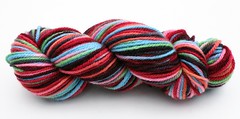
The other one was Inked, on Canadian BFL. I just like something about how these particular shades work together.

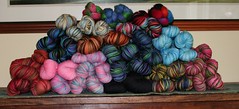
You can see the Flickr photo with notes on the colorway names here:
http://www.flickr.com/photos/huckleberryknits/3279835348
I had two favorite results out of this batch. One was Morgaine, on Corriedale. The photo doesn't show it well, but there are lots of intermediate shades of blue, green, and purple in the two skeins.

The other one was Inked, on Canadian BFL. I just like something about how these particular shades work together.
Thursday, December 11, 2008
rainbows
A lovely customer requested some rainbow colorways with no purple in them. So I handpainted a couple, one with brown:


They weren't quite as vivid as I thought she'd like, especially the one with brown. So a few nights later, I redyed the chocolate rainbow (my inaugural skein from my night-ready dye studio):

Much more vibrant. This skein was space-dyed, which I find produces the most even color throughout a skein, and sometimes (as in this case) richer colors. The drawback is that it takes a while for me to do.
The customer likes the more saturated colors, as I thought she would. So I'll be hitting the rainbow dyepots again shortly for another go at the rainbow with no purple. My second Ott-Lite showed up today and makes a big difference, so I'm looking forward to some productive evenings in my new workspace.


They weren't quite as vivid as I thought she'd like, especially the one with brown. So a few nights later, I redyed the chocolate rainbow (my inaugural skein from my night-ready dye studio):

Much more vibrant. This skein was space-dyed, which I find produces the most even color throughout a skein, and sometimes (as in this case) richer colors. The drawback is that it takes a while for me to do.
The customer likes the more saturated colors, as I thought she would. So I'll be hitting the rainbow dyepots again shortly for another go at the rainbow with no purple. My second Ott-Lite showed up today and makes a big difference, so I'm looking forward to some productive evenings in my new workspace.
Monday, November 24, 2008
someday, perhaps I'll remember ...
... that when I use black dye, the dye is at a much higher concentration than the other colors, and will run a lot more. So when I put it in the middle of a skein, it will spread a lot further than the other colors when I wrap it up in plastic to steam it.
Sigh. Someday I'll stop relearning these lessons the hard way.
But maybe this won't be an issue for too much longer. I've been thinking for a while that I'd like to cut down on my use of plastic as much as possible. I recently saw a presentation by the director of the Port Townsend Marine Science Center on the problem of massive plastics pollution in the world's oceans. It was kind of horrifying, actually. The poster child for the problem is the Laysan albatross, where each breeding pair produces one chick a year. The parents fly for many miles in search of food to bring back to their chick, and in recent years, they've been mostly bringing back plastic. A 1994 study autopsied 251 albatross chicks; only six did not have plastic in their digestive system. (Another source says that the most commonly found item is a Bic lighter.) The plastic causes malnutrition of course, since the parents aren't bringing back real food; it also causes blockages that keep the chicks from getting rid of squid beaks and other nondigestibles.
Anyway. I want to cut down on how much plastic I use. I try to be conscious of the packaging of the items that I buy, I reuse ziplocs, etc. I also want to try to do something about how I dye, since my current method of handpainting involves wrapping skeins in plastic wrap before steaming. I was thinking that I might get a steamer pan set, but because each pan has holes, all the skeins would need to be the same colorway and be precisely arranged so that the dye dripping through the holes didn't discolor the skein below. There are those big restaurant chafing dishes, but those are pretty expensive. I could put them in the oven, but I'm trying to get my dyeing work out of the kitchen. Yeah, I'm not sure what the answer is yet.
Sigh. Someday I'll stop relearning these lessons the hard way.
But maybe this won't be an issue for too much longer. I've been thinking for a while that I'd like to cut down on my use of plastic as much as possible. I recently saw a presentation by the director of the Port Townsend Marine Science Center on the problem of massive plastics pollution in the world's oceans. It was kind of horrifying, actually. The poster child for the problem is the Laysan albatross, where each breeding pair produces one chick a year. The parents fly for many miles in search of food to bring back to their chick, and in recent years, they've been mostly bringing back plastic. A 1994 study autopsied 251 albatross chicks; only six did not have plastic in their digestive system. (Another source says that the most commonly found item is a Bic lighter.) The plastic causes malnutrition of course, since the parents aren't bringing back real food; it also causes blockages that keep the chicks from getting rid of squid beaks and other nondigestibles.
Anyway. I want to cut down on how much plastic I use. I try to be conscious of the packaging of the items that I buy, I reuse ziplocs, etc. I also want to try to do something about how I dye, since my current method of handpainting involves wrapping skeins in plastic wrap before steaming. I was thinking that I might get a steamer pan set, but because each pan has holes, all the skeins would need to be the same colorway and be precisely arranged so that the dye dripping through the holes didn't discolor the skein below. There are those big restaurant chafing dishes, but those are pretty expensive. I could put them in the oven, but I'm trying to get my dyeing work out of the kitchen. Yeah, I'm not sure what the answer is yet.
Monday, August 11, 2008
some thoughts about production dyeing
I'm on my third colorway for the co-op right now, and it has definitely been an educational experience.
My first conclusion: I need one of these electric skein winders from Crazy Monkey Creations. I wound several skeins for dyeing yesterday, and my arm is still sore today. The electric winders should be back in stock next week, and I'm going to save up all the reskeining till I get one.
Second conclusion: Don't try a new dyeing technique when you're short on a particular base yarn, to cut down on that gotta-get-it-right stress. Space dyeing is my favorite technique for consistency of color, but it's pretty slow, so I bought some enormous cooling racks and some giant squeeze bottles at a restaurant supply store, and dyed with those. Yes, it was fast--I dyed six skeins in about 90 minutes, versus the four skeins that I space-dyed tonight over three hours. And you can get much shorter color repeats. But I'm having to do a fair amount of tweaking with dye formulas to get the exact shades that I'm looking for, even with colors that I've been dyeing for two years.
Third conclusion: This is a really great way to see how differently base yarns take dye. For example, Gaia merino wicks dye much faster than any other base yarn I have right now. And when you put dye on superwash, it just sits there, where you put it, which can lead to much higher concentrations of color than you expected.
I think that with most of my remaining colorways, I'm going to go to my slow but consistent and proven methods. I'm trying hard to match my stock photos, and boosting my production while experimenting with new techniques is causing more variation than I'd like. I'll be doing a local fiber show in October, so I'll work on perfecting my production dyeing then.
My first conclusion: I need one of these electric skein winders from Crazy Monkey Creations. I wound several skeins for dyeing yesterday, and my arm is still sore today. The electric winders should be back in stock next week, and I'm going to save up all the reskeining till I get one.
Second conclusion: Don't try a new dyeing technique when you're short on a particular base yarn, to cut down on that gotta-get-it-right stress. Space dyeing is my favorite technique for consistency of color, but it's pretty slow, so I bought some enormous cooling racks and some giant squeeze bottles at a restaurant supply store, and dyed with those. Yes, it was fast--I dyed six skeins in about 90 minutes, versus the four skeins that I space-dyed tonight over three hours. And you can get much shorter color repeats. But I'm having to do a fair amount of tweaking with dye formulas to get the exact shades that I'm looking for, even with colors that I've been dyeing for two years.
Third conclusion: This is a really great way to see how differently base yarns take dye. For example, Gaia merino wicks dye much faster than any other base yarn I have right now. And when you put dye on superwash, it just sits there, where you put it, which can lead to much higher concentrations of color than you expected.
I think that with most of my remaining colorways, I'm going to go to my slow but consistent and proven methods. I'm trying hard to match my stock photos, and boosting my production while experimenting with new techniques is causing more variation than I'd like. I'll be doing a local fiber show in October, so I'll work on perfecting my production dyeing then.
Monday, July 21, 2008
dyer's woad
My friend Lisa gave me a couple of books for my birthday this year, A Dyer's Garden and A Weaver's Garden. I don't have nearly enough yard space to raise any of these plants (the books estimate needing as many as 24 plants to dye a scant 4 oz of yarn), but I've gotten interested in the idea of using ones that are noxious weeds around here. They're plentiful and I'd be doing the rest of the ecosystem a favor by using them for something practical.
I love indigo, but given that it thrives in places like South Carolina and southeast Asia, I can't make a go of growing it here. Dyer's woad has the same chemical (though in smaller amounts) and grows in Great Britain--a similar climate to here. The catch is that to use woad in a non-commercial form that would avoid the use of lye and such, the leaves must be absolutely fresh, so I have to go foraging for them.
So I looked up dyer's woad and it is classified as a Class A noxious weed in this county--a real nasty. I e-mailed the local noxious weed control coordinator, who is a friend of mine, to see if she could recommend any likely patches.
Alas! Except for one tiny patch in Kittitas County, she says that dyer's woad has been eradicated from Washington state. Quite an achievement--usually Class A weeds are unstoppable--but I am selfishly sad for my big plans ending up in the toilet.
She did say that it is still found in Idaho, where I'll be camping next week. I think I'm going to have to lug along some yarn and a dyepot, just in case. Otherwise, I'll probably be experimenting with purple loosestrife and Scotch broom, which are two nasties that are taking over the countryside.
I love indigo, but given that it thrives in places like South Carolina and southeast Asia, I can't make a go of growing it here. Dyer's woad has the same chemical (though in smaller amounts) and grows in Great Britain--a similar climate to here. The catch is that to use woad in a non-commercial form that would avoid the use of lye and such, the leaves must be absolutely fresh, so I have to go foraging for them.
So I looked up dyer's woad and it is classified as a Class A noxious weed in this county--a real nasty. I e-mailed the local noxious weed control coordinator, who is a friend of mine, to see if she could recommend any likely patches.
Alas! Except for one tiny patch in Kittitas County, she says that dyer's woad has been eradicated from Washington state. Quite an achievement--usually Class A weeds are unstoppable--but I am selfishly sad for my big plans ending up in the toilet.
She did say that it is still found in Idaho, where I'll be camping next week. I think I'm going to have to lug along some yarn and a dyepot, just in case. Otherwise, I'll probably be experimenting with purple loosestrife and Scotch broom, which are two nasties that are taking over the countryside.
Monday, June 23, 2008
more adventures in dyeing black
So I finally dyed some yarn with my sorta new black dye, following the instructions. The first two skeins will come out okay, I think, though I'm not entirely sure about the green.
I had some dye left over, so I dyed up a skein of superwash merino that I hadn't used before. This one was a bit of a disaster--the dye did not penetrate evenly, so I had to basically paint individual strands, but I didn't have enough room because of the other two skeins that were still curing in my work space, so the dye job probably wasn't very tidy. And the black dye, which was basically a slurry, got smeared in places where it wasn't supposed to be. Guess this one will be a tester skein for me.
I had some dye left over, so I dyed up a skein of superwash merino that I hadn't used before. This one was a bit of a disaster--the dye did not penetrate evenly, so I had to basically paint individual strands, but I didn't have enough room because of the other two skeins that were still curing in my work space, so the dye job probably wasn't very tidy. And the black dye, which was basically a slurry, got smeared in places where it wasn't supposed to be. Guess this one will be a tester skein for me.
Subscribe to:
Posts (Atom)


 Posts
Posts


